1.2 The Big Picture of Development
Development changes how the parts and activities of a living individual work together. What an individual can do at any point depends on what has already developed, and what happens next grows out of that history. But an individual developmental history does not unfold on its own. It takes place within circumstances that were already there and that have histories of their own. This raises a broader question about developmental explanation: How far back, and across what kinds of history, do we need to look in order to understand how a developmental process comes about?
We can ask how an activity is produced in the present moment, how a capacity emerged over an individual life, how the circumstances in which development takes place have been recreated or changed across generations, or how developmental processes themselves arose in evolutionary history. These questions are connected, but they do not call for the same kind of answer. Development is usually studied with the developing individual in focus, but explaining what happens in an individual life can require moving beyond the boundaries of that life.
The same phenomenon can lead us into different histories, depending on what we want to explain. We will call these different ways of locating a question explanatory frames.
To illustrate this idea of frames, think about an infant learning to walk. At a very short timescale, we can ask how posture, balance, vision, and movement are coordinated during a particular step. At the timescale of the individual child, we can ask how walking emerged through an earlier history of bodily growth, activity, and experience. We can also ask about the surroundings and practices in which the child is learning to move around, and how these have been maintained or changed across generations. At a much longer timescale, the bodies and developmental processes that make human walking possible have an evolutionary history. These questions concern the same developing capacity, but each follows a different process or history.
A Map of Developmental Questions
In the way that we usually think about it, the study of development primarily focuses on the developing individual. Developmental psychology, for instance, asks how people change over their lives. We can call this focus the ontogenetic frame, since ontogeny typically refers to development over the individual lifespan. If we want to explain how a capacity or pattern of activity develops in this frame, we look to that person’s history across months, years, and decades.
Although the ontogenetic frame focuses on an individual life, explaining what happens within that life can require following histories that extend beyond it. The circumstances in which an organism develops have histories that extend across generations, while the organization of developmental life cycles has an evolutionary history. Development therefore crosses timescales as well as disciplinary boundaries. To follow these histories, developmental psychologists and neuroscientists may need to draw on work in other fields.
Keeping the developing individual in focus does not make it a passive point at which these longer histories arrive. The organism acts within the circumstances in which it develops, and its activity can change them. Looking across frames lets us follow those connections.
We can first look at frames that span longer timescales. For example, the connections between development and evolution that were mentioned above are about the linkage between ontogeny (individual development) and phylogeny (evolutionary history). This brings us to the phylogenetic frame, which is at the evolutionary scale.
We often think about evolution in terms of differences among species or adult forms, but evolutionary change also involves changes in the life cycles through which those forms arise. Members of a species typically share a broad sequence of developmental phases. Changes in that sequence connect ontogeny with phylogeny.
The ontogenetic and phylogenetic frames are both about change: they are dynamic frames concerned with change over the individual lifespan (ontogeny) and over very long periods of evolutionary time (phylogeny). We can also consider another dynamic frame, the diachronic frame, which concerns how developmental circumstances and practices are maintained and changed across successive generations.
The diachronic frame applies to living things more generally, not only to humans. Think of an individual frog developing in a particular pond. Beyond that frog’s own developmental history, there is the history of that pond and of the local population to which the frog belongs, including whatever has happened to both over recent decades. Those conditions shape what is possible for this frog, but they are neither ontogenetic nor phylogenetic.
In the human case, the diachronic frame takes on further importance because our practices are not only carried forward through participation but can be deliberately taught, represented in language, and stabilized in artifacts and institutions. The activity of people who are no longer present can therefore continue to organize the circumstances in which later generations develop. Some of these histories can also become part of what developing individuals know. People can learn about practices and institutions that existed before them and choose whether to continue them.
Here the diachronic frame is often the frame of “history”, in the sense of the history of the collective endeavors of humans. Some human diachronic processes turn out to be deeply connected to the phylogenetic frame, as with cooking, tool use, and cooperative childcare. Others are more recent and specific, such as the use of screens, and are much less connected to phylogenetic change.
The Example of Language
In Natural Causes of Language (2014), the linguist N. J. (Nick) Enfield distinguishes several kinds of questions we can ask about language. He organizes these questions through six “causal frames”: microgenetic, enchronic, ontogenetic, diachronic, phylogenetic, and synchronic. Each frame picks out different processes and relations. A fuller explanation requires us to understand both what each frame reveals and how the processes considered in different frames are connected.
In the ontogenetic frame, we ask how an individual child comes to understand and use language. In the diachronic frame, we ask how languages are maintained and changed across generations, including how they diverge from one another. In the phylogenetic frame, we ask how the human capacity for language arose in evolutionary history. These questions concern different kinds of change, rather than simply different lengths of time.
Enfield also distinguishes processes operating over shorter timescales. The microgenetic frame concerns processes through which words are perceived, produced, remembered, or understood. The enchronic frame concerns the unfolding sequence of social interaction, including how one speaker’s turn creates conditions for the next. Understanding a word and coordinating a conversation are closely related, but explaining one does not by itself explain the other.
The synchronic frame concerns the organization of a language at a particular point in time: a map of its current system of relations. Such a description can help us understand how a language works, while leaving open questions about how that organization arose and how it is maintained.
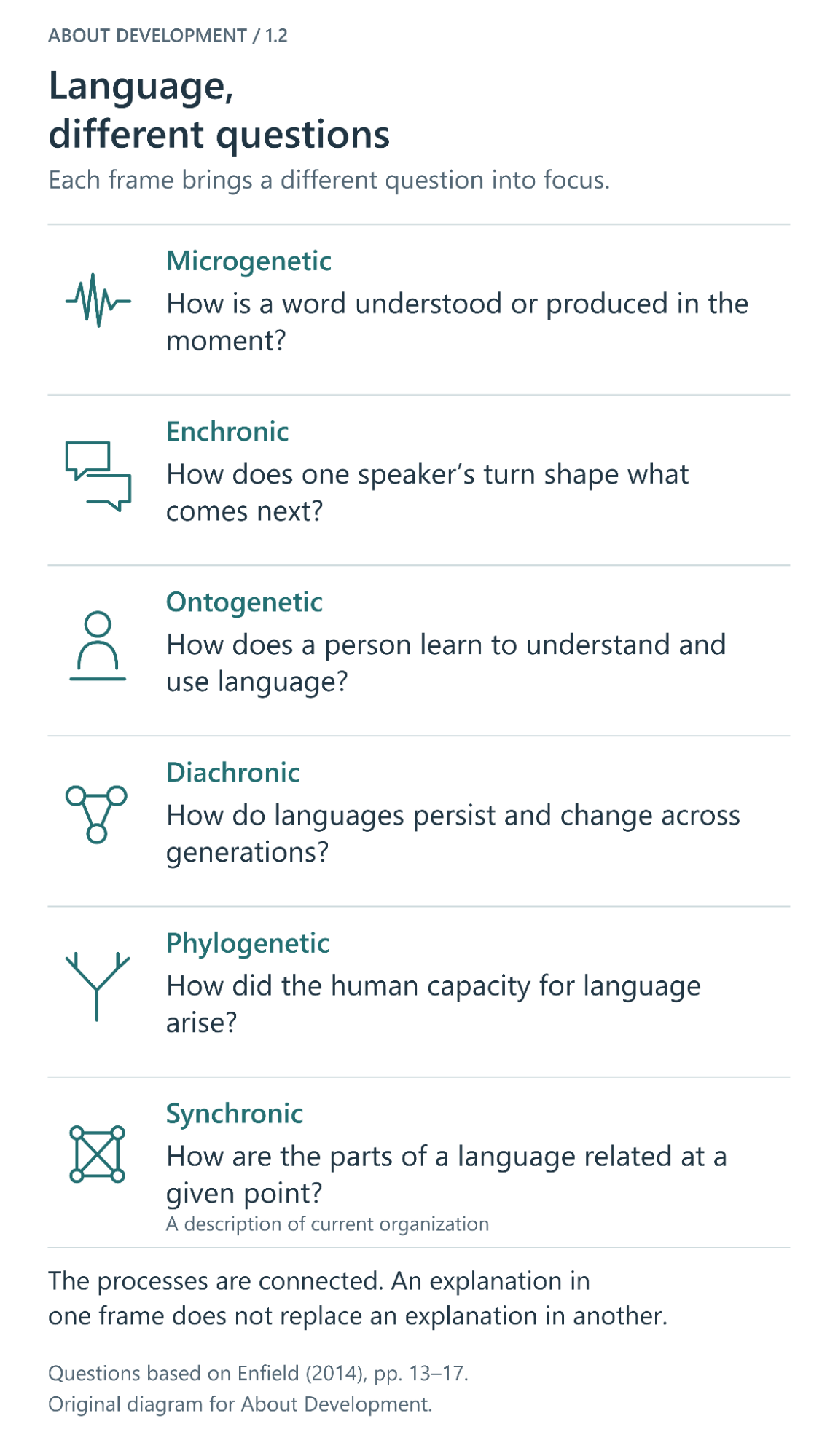
The frames pick out different processes, but they do not divide language into separate parts. They are also our own construction, a way of organizing questions, and not a mirror of how nature itself is divided. A child learns to speak through participation in practices through which a language is also maintained and changed. The child’s learning and the history of the language are different processes, yet each is important for understanding the other. Explaining either one means keeping that difference while showing how the two processes are connected.
For the questions pursued in About Development, four dynamic frames will receive particular attention: microgenetic, ontogenetic, diachronic, and phylogenetic. The enchronic frame becomes important when social interaction itself is the focus of explanation. The synchronic frame describes how things are organized at a given point; the other frames help us ask how they came to be that way and how they continue.
Explaining Developmental Change
Research in psychology and neuroscience often describes capacities or patterns of activity as they exist at a particular point in time. Such descriptions can establish what is organized and how it works, while leaving open how that organization developed. Collecting data at different time points or comparing people of different ages can show us that change has occurred, but simply describing the differences does not necessarily provide a developmental explanation.
The further question is how the later capacity emerged from what was there before. Answering that question means tracing the activity and conditions through which it took shape and became established. Present mechanisms still matter, and this places them within the history through which the capacity arose.
A study can reasonably concentrate on one frame, but the processes it examines depend on conditions that the study may take for granted. What happens at one scale depends on conditions with histories at other scales, while activity at one scale can also alter the conditions under which later development occurs. Looking across frames therefore helps us ask what kind of history is needed to explain the developmental event in front of us.
One especially important connection is between the ontogenetic and phylogenetic frames. Individual organisms develop through life cycles, while the general organization of those life cycles also has an evolutionary history. Evolution therefore need not be pictured as producing finished adult forms that development later reveals. The neural tube, the embryonic structure that becomes the brain and spinal cord, is a good example. In any vertebrate embryo it is new, since it was not there a few days earlier, but it is also old: it formed in countless earlier generations, and it forms again because the processes that build it are reliably reconstructed. Neural tubes have not always existed. What evolved were the developmental processes that produce one.
Sources
Enfield, N. J. (2014). Natural causes of language: Frames, biases, and cultural transmission. Language Science Press. https://doi.org/10.17169/FUDOCS_document_000000021399
Explore Further
Marshall, P. J. (2014). Beyond different levels: Embodiment and the developmental system. Frontiers in Psychology, 5, 929. https://doi.org/10.3389/fpsyg.2014.00929
A discussion of why different kinds of explanation should not be seen as separate levels, and of how organization and process are related in a developmental system.