1.4 The Origins of Multicellular Development
An organism can be understood as a developmental process within a recurring life cycle. But life cycles themselves have histories. The elaborate life cycles through which animals and other multicellular organisms construct differentiated bodies have not always existed. They evolved from forms of life in which cells lived and reproduced without building bodies made of many different kinds of cells.
This reading therefore asks a phylogenetic question about development. It is not asking how life itself began, or suggesting that development began only with multicellularity. Many unicellular organisms pass through differentiated developmental stages, including the formation of highly resistant spores under particular conditions, and the developmental biologist Alessandro Minelli (2021) argues that some single-celled organisms change enough in form across their life cycles to count as developing. The question is how a new kind of development became possible: how cells came to construct and maintain an integrated individual composed of many cells with different roles.
Seen from this perspective, a multicellular body is itself a developmental achievement. The processes that make such bodies possible arose over evolutionary time, but they must be carried out again in every life cycle.
From Cells to Bodies
Over the long history of living things, some cells began to remain together or to come together in recurring multicellular forms. All animals and plants, many fungi, and some less familiar organisms are multicellular in one way or another. Single-celled organisms carried on doing just fine, as they still do. They were joined by new ways of living in which the persistence of the individual depended on relations among many cells.
Multicellularity arose repeatedly rather than appearing once and then being inherited by every multicellular lineage (Niklas & Newman, 2020). Many of these forms were relatively simple collections of similar cells. In some lineages, however, multicellularity brought bodies onto the scene: integrated individuals containing different kinds of cells with different roles.
A body develops as cells multiply and become different from one another, and their activities have to remain coordinated as this happens. An adult human body contains tens of trillions of its own cells, of a few hundred different types (Sender et al., 2016; Vickaryous & Hall, 2006), and somehow they hold together as one individual. Multicellularity therefore changes the explanatory problem. It is no longer enough to explain what one cell does; we need to explain how the activities of many cells produce and maintain one organized individual.
When we think about multicellularity, we may mainly picture animals, although being multicellular does not necessarily mean having a body with many differentiated cell types. Simple forms include filaments, clusters, balls, or sheets of cells, while more integrated and differentiated bodies are found in animals, plants, and some fungi.
Simple multicellularity has evolved many times and also occurs in some prokaryotes, including cyanobacteria, so the boundary between unicellular and multicellular life is less tidy than it first appears.
Cells in simple multicellular forms can adhere to one another, communicate, and alter their activity in relation to their position in the group. More complex multicellularity involves more elaborate signaling and differentiation, along with the regulation of growth and cell death, through which the body is constructed and maintained.
Animals, plants, and fungi evolved complex multicellularity in different ways, so there is no single developmental solution to the problem of building a body. What these lineages share is the need to coordinate many cells across a life cycle while preserving the organization of the individual as a whole.
Paths to Being Multicellular
Multicellularity can arise in at least two broad ways. In a “staying together” route, a cell divides and its descendants remain attached, forming a clonal group. In a “coming together” route, cells that were previously living separately aggregate into a group. Both routes can produce coordinated multicellular forms, but they create different developmental problems (Grosberg & Strathmann, 2007).
Protists are useful for seeing this range because they include many primarily unicellular organisms as well as forms that establish temporary or recurring multicellular relations. They are also important to the history of animals, whose closest known living relatives are choanoflagellates. Comparative genomic work shows that some molecular components later used in animal cell adhesion and signaling were already present in unicellular relatives of animals (King et al., 2008).
The social amoeba Dictyostelium discoideum provides a striking example of the coming-together route. Its cells ordinarily live separately, but when resources become scarce they aggregate into a moving slug and then form a fruiting structure. Some cells become spores, while others form the stalk that supports them (Schaap, 2011). This is a multicellular phase with differentiation and coordination, but it is constructed by assembling previously independent cells rather than by developing from one cell that divides.
Animals exemplify the staying-together route. In a typical animal life cycle, a fertilized egg divides, and the resulting cells remain parts of one developing individual. This route passes through a unicellular bottleneck in which the organism is one cell, followed by a one-to-many process through which that cell gives rise to the differentiated body. Animals that reproduce by budding or fragmentation do not pass through this bottleneck in every reproductive event. This clonal route does not by itself explain how the body becomes organized, but it changes the conditions under which coordination must be achieved.
The contrast also reveals a further problem: when independently living cells come together, their interests do not automatically coincide, and some cells may contribute less while gaining more of the reproductive benefit. Developing from one cell produces a body whose cells are usually very closely related, which reduces one source of conflict.
Complex multicellularity involves cells becoming interdependent parts of a larger living organization. This is sometimes described as cells giving up an independent lifestyle, although the cells of an animal body are not independent organisms that repeatedly choose to cooperate. Their activities and possibilities take shape through their relations within the developing body.
Relatedness, which results from the single-cell bottleneck, may help keep that integration stable, but it does not build a body. A body made of identical cells all doing the same thing would not be a complex body, so cells have to become different from one another while continuing to function as parts of the same individual.
What Multicellularity Made Possible
Multicellularity did not arise because unicellular organisms had somehow failed by remaining small. Unicellular life occupies an enormous range of environments and shows forms of organization and activity that are highly successful on their own terms. The more useful question here is what changed when cells began to live together in new ways.
In the staying-together route, the descendants of a dividing cell remain attached. Once cells are together, their physical relations alter what each cell can do, creating opportunities for signaling, differentiation, and division of labor. A small change in how cells separate can therefore establish a new developmental situation.
Thinking about this transition, we should not imagine that evolution was directing unicellular organisms toward multicellularity, or that natural selection first specified a useful kind of body and then found a way to build it. Selection can act only on variation that already exists.
The developmental biologist Stuart Newman and his colleagues propose a scenario for the origins of animal bodies in which a change in organization opens new developmental possibilities. In this account, once cells remained together, the aggregate became a new kind of material system: adhesion, arrangement, local signaling, diffusion, and mechanical interactions could generate forms and relations that were not available to isolated cells. Across generations, genetic changes and natural selection could stabilize viable forms and make their development more reliable (Newman et al., 2006). This illustrates a broader view: development helps generate the possibilities that evolution works with, while natural selection helps determine which of those possibilities persist.
There may be no single answer to why multicellularity arose, since different transitions occurred through different routes and under different conditions. Considering energy flow by itself does not explain any of those transitions. It does, however, help us see some of the possibilities opened by living at a larger scale. Larger multicellular bodies could occupy new niches, gain access to new resources and energy flows, and support greater specialization among their parts. These possibilities also came with costs. Every organism lives within a particular range of energy flow: too little and it dies, and too much and it also dies. A larger differentiated body needs sustained flows of energy and materials, along with continuing coordination and repair, and this makes big, complex organisms more vulnerable to changes in their surroundings than small, simple ones (Marshall et al., 2021).
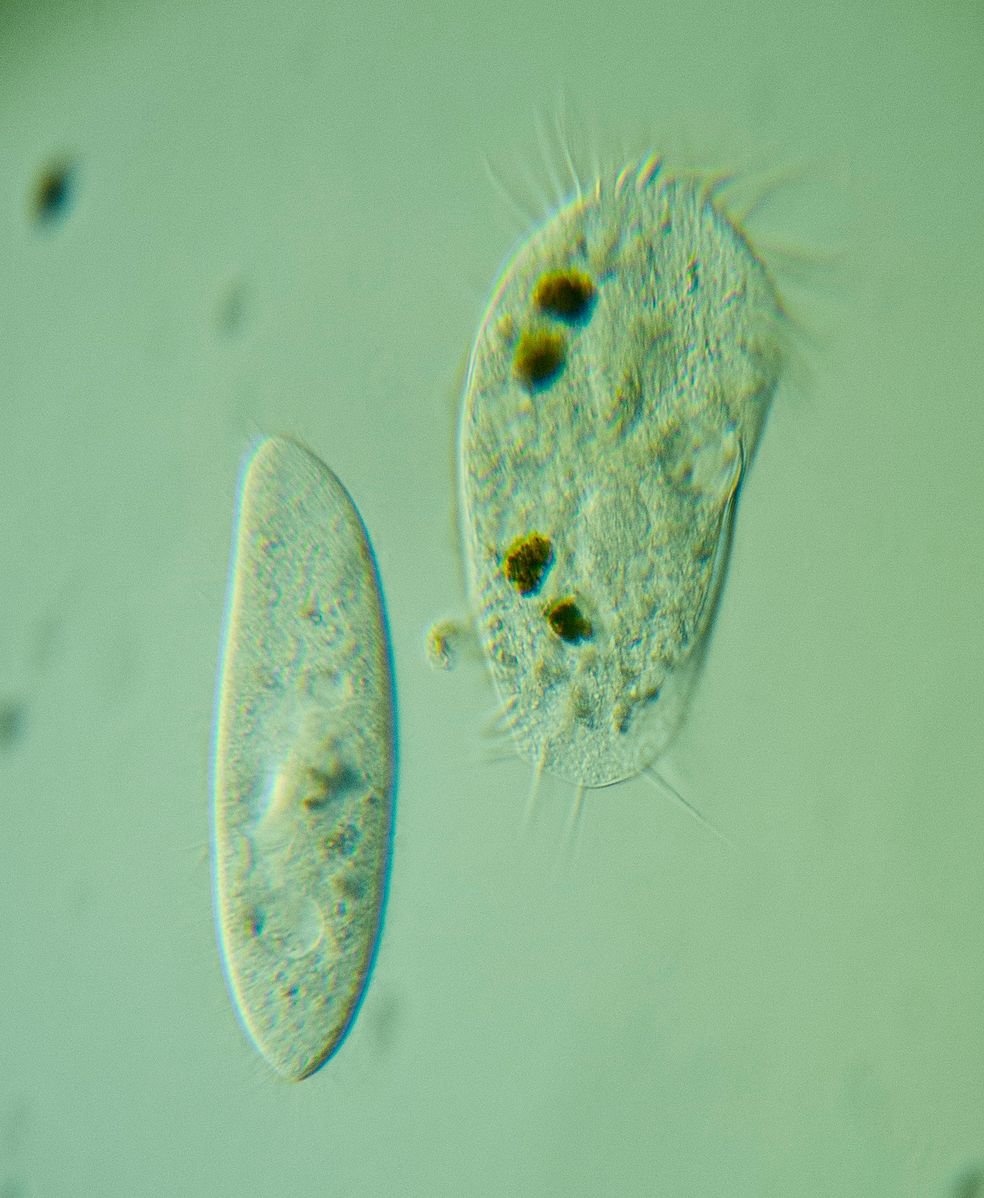
The single-celled organism Paramecium helps make the importance of scale more concrete. It is a fraction of a millimeter long, moves through water using cilia, and ingests smaller microorganisms, but all of its activities must be carried out within one cell. At a different scale, different ways of moving and coordinating activity become possible.
For psychology, this is important because behavior did not begin with brains, but brains arose within the evolution of increasingly complex multicellular bodies. Sponges, which have no nervous system, and jellyfish, which have nerve nets but no brain, show that an animal body can live and act without one. The capacities of an animal depend on the kind of body it develops and the world through which that body can move, perceive, and act. Nervous systems enter the story as one way of coordinating those bodies and their activities, but development is already present in the processes through which the body itself is repeatedly brought into being.
The evolution of multicellularity did more than add cells together. It created a new developmental problem: how many cells could become different while remaining coordinated as one living individual. The processes that build a multicellular body, such as cell division, signaling, differentiation, movement, adhesion, and regulated cell death, also had to evolve. Once cells began developing together, each cell encountered conditions that it would not have encountered on its own.
Multicellular development is strikingly reliable, but where does that reliability come from? If the organization of the body is not simply present at the beginning, how does it arise so dependably through development? This question has a long history, including a debate between two very different answers.
Sources
Grosberg, R. K., & Strathmann, R. R. (2007). The evolution of multicellularity: A minor major transition? Annual Review of Ecology, Evolution, and Systematics, 38, 621–654. https://doi.org/10.1146/annurev.ecolsys.36.102403.114735
King, N., Westbrook, M. J., Young, S. L., Kuo, A., Abedin, M., Chapman, J., Fairclough, S., Hellsten, U., Isogai, Y., Letunic, I., Marr, M., Pincus, D., Putnam, N., Rokas, A., Wright, K. J., Zuzow, R., Dirks, W., Good, M., Goodstein, D., … Rokhsar, D. (2008). The genome of the choanoflagellate Monosiga brevicollis and the origin of metazoans. Nature, 451, 783–788. https://doi.org/10.1038/nature06617
Marshall, P. J., Houser, T. M., & Weiss, S. M. (2021). The shared origins of embodiment and development. Frontiers in Systems Neuroscience, 15, 726403. https://doi.org/10.3389/fnsys.2021.726403
Minelli, A. (2021). Understanding development. Cambridge University Press. https://doi.org/10.1017/9781108872287
Newman, S. A., Forgacs, G., & Müller, G. B. (2006). Before programs: The physical origination of multicellular forms. International Journal of Developmental Biology, 50(2–3), 289–299. https://doi.org/10.1387/ijdb.052049sn
Niklas, K. J., & Newman, S. A. (2020). The many roads to and from multicellularity. Journal of Experimental Botany, 71(11), 3247–3253. https://doi.org/10.1093/jxb/erz547
Schaap, P. (2011). Evolutionary crossroads in developmental biology: Dictyostelium discoideum. Development, 138(3), 387–396. https://doi.org/10.1242/dev.048934
Sender, R., Fuchs, S., & Milo, R. (2016). Revised estimates for the number of human and bacteria cells in the body. PLoS Biology, 14(8), e1002533. https://doi.org/10.1371/journal.pbio.1002533
Vickaryous, M. K., & Hall, B. K. (2006). Human cell type diversity, evolution, development, and classification with special reference to cells derived from the neural crest. Biological Reviews, 81(3), 425–455. https://doi.org/10.1017/S1464793106007068