1.3 Life Cycles and the Direction of Development
One unmistakable aspect of development is that it proceeds through time. Whether we like it or not, we all get older. Development therefore appears to have direction, although this is not necessarily the same as being directed towards something. This reading asks what kind of direction development has.
If you were asked what development is directed towards, your first answer might be adulthood. We talk about children as growing up, and we often look back on childhood as a path towards adult life. But does that make adulthood the goal of development?
In ordinary life, we do not encounter a child only as a future adult. We see a child living a childhood, with activities and concerns of their own. But when we try to explain development, should a child be understood as an adult in the making? Or does each phase of a life have significance beyond preparing for what comes later?
This is a question about teleology, or explanation in terms of an end or goal. Aristotle’s “Four Causes” give a point of reference to work from (Falcon, 2023).
Aristotle’s word for these causes was aition, which is closer to “explanatory factor” than to cause in our modern sense. Each answers a different kind of question about a thing:
What the thing is made of (the material cause)
The characteristics that make it what it is (the formal cause)
What brought it into being (the efficient cause)
What it is for, or the end towards which it is directed (the final cause)
Teleology concerns the final cause, or the telos: that for the sake of which something happens. Biology uses this kind of explanation all the time, as when we say that the heart is for pumping blood or that a bird’s wings are for flying. A teleological view of development treats it as directed towards a particular end state. If we treat the adult as that destination, earlier phases can seem meaningful only as steps towards what comes later. Looking at the life cycle as a whole suggests another way to think about direction.
Psychological Perspectives on Developmental Direction
Behind the question of whether development is directed towards an outcome is the human tendency to look for reasons and goals in the processes we are trying to understand. When we say that a child is developing towards maturity or independence, we are not simply describing biological change. We are also bringing in ideas about what a life should become. Who decides what the outcome of development should be? In part, the people describing it do, which makes development a partly normative concept: descriptions of development can include judgments about which changes are desirable or count as improvement.
Beyond the study of children, lifespan developmental psychology made this issue more visible by treating development as a lifelong process involving losses as well as gains, rather than as a journey that ends with adulthood (Baltes, 1987). Narrative approaches emphasize the stories through which people understand where their lives have come from and where they are going. These stories draw on broader cultural narratives about what a life can or should become (McLean & Syed, 2015). Developmental direction can therefore be something that people interpret within their own lives, as well as something described by an observer.
These approaches help us understand what people want from their lives and where those expectations come from. But they do not settle the biological question of whether development itself is directed towards a final state. To approach that question, we need to shift from the goals that people assign to development to the organization of the life cycle through which an organism persists and changes.
Life Cycles as the Biological Context of Development
What does a biological perspective say about whether development is directed towards a particular outcome? One answer comes from thinking about life cycles. Each organism follows a developmental trajectory that shares a broad organization with those of other members of its species, although the details vary between individuals and environments.
The frog life cycle below shows the familiar sequence from eggs through tadpole and froglet stages to reproductive adulthood, after which a new generation begins. This recurring trajectory has been stabilized, at least for now, through evolution. Life cycles therefore help us see the close relationship between development and evolution, since evolutionary change includes changes in the organization of developmental life cycles across generations.
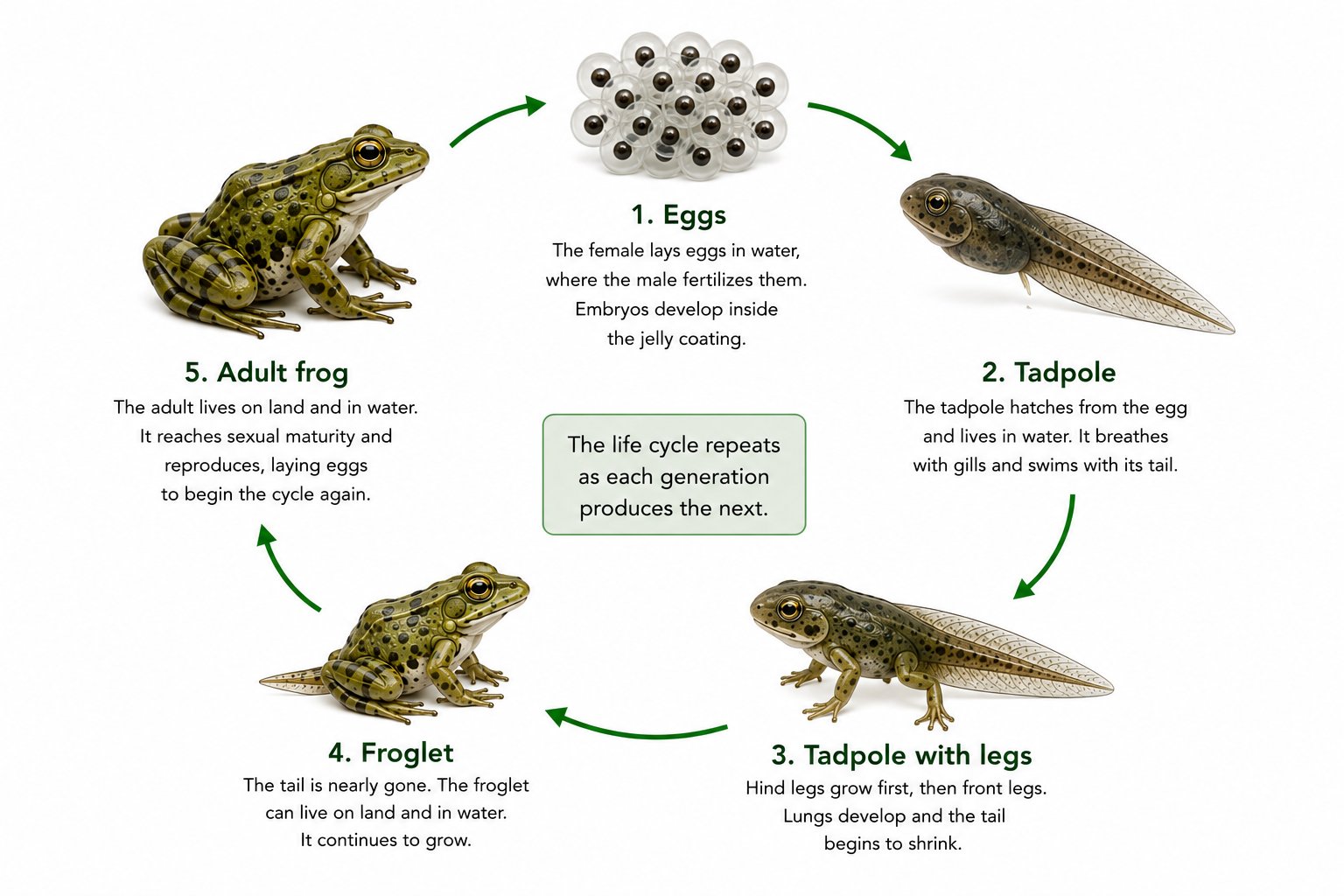
The main point of thinking about life cycles here is that when we look at frog eggs, a tadpole, or an adult frog, we are looking at snapshots of different points in one life cycle. Although we generally reserve the word “frog” for the adult form, the organism’s history also includes the egg, tadpole, and froglet. We have practical reasons for dividing the life cycle into phases. We also assign different values and roles to those phases, often treating the adult as the form that matters most. Frogs are unlikely to care about any of this, but we do this in human development as well – and we can reflect on it. Children are not the same as adults, for good reasons, but childhood is not only a preparation for what comes later.
We may often see the individual life cycle as being directed towards an adult outcome representing the most “complex” state that the individual will attain. This fits a familiar picture of animal development, but it does not provide a general definition. The biologist Alessandro Minelli challenges what he calls adultocentrism in the study of development: the assumption that earlier phases derive their meaning from the adult form towards which they appear to be moving (Minelli, 2021, Chapter 1). He points out that however we define development, biological diversity is likely to reveal cases that strain the definition. Parasitic flukes give one example. In their life cycle the free-swimming larva, with its cilia and eyespots, gives way to simple sac-like stages that reproduce asexually, and the more complex forms return only later, in the stages that lead to the adult. Reproductive maturity therefore does not always coincide with the most complex form. Development also does not always begin from a fertilized egg, and substantial developmental change can continue after reproduction has begun.
The life cycle diagram above begins at fertilization and ends with reproduction, and indeed that is typically how we think about an individual life cycle. But any point we call the beginning of development already depends on living cells, and on processes that continue from an earlier generation, while the production of gametes carries the process forward into the next one. In this broad biological sense, individual organisms come and go while life cycles keep cycling. Development can then be understood as an open-ended segment of life rather than as a self-contained process with a single starting point (Minelli, 2011).
An individual life still has a beginning and an end in the ordinary sense, and the individual still matters. Its developmental process is nested within a longer continuity of living organization.
The Organism as a Developmental Process
If we cannot say that the life cycle is simply about increasing complexity, and is not just directed towards adulthood, how should we think about its direction? One answer is to stop treating the adult organism as the finished thing toward which the earlier stages are merely working. An adult frog, like an egg or a tadpole, is one phase of a life cycle. No single stage can stand for the whole process, and we need to understand how each phase develops from the preceding one. But we can also do that without assuming that adulthood gives the whole cycle its direction.
One way to approach the question of teleology is to see an organism as a process. The philosopher of biology Amanda Corris describes organisms, from this perspective, as developmental processes embedded within wider developmental systems (Corris, 2022).
Developmental Systems Theory, which will be taken up more fully in a later reading, offers one approach to these issues. It treats development as arising through the coordinated activity of many resources, both within and beyond the organism, rather than through the unfolding of a plan contained inside it. The organism is the living process that persists through its changes in form. That process unfolds through a wider system of developmental resources, including cells and molecules within the organism, but also recurring relations with an ecological niche and with other organisms.
A frog is still an individual with its own organization and activity. The life through which that individual persists and changes cannot be separated from the wider conditions through which it is constructed. In this sense, the organism is both an individual and a process, while the developmental system is the wider set of relations and resources through which the individual life unfolds and the general organization of the life cycle is reproduced across generations.
From this perspective, a life cycle has direction without necessarily being directed towards a final form in the way that a plan is directed towards a finished product. The path already taken changes what can happen next by opening some possibilities and closing off others. A frog egg does not become just anything, but neither does it contain the adult frog as an outcome already present in miniature or as a destination that development has to reach. What recurs is a developmental process whose direction arises through its own unfolding history.
Does this process-oriented view make all teleological language useless? Probably not. The developmental theorist Willis Overton notes that in the study of development, we construct principles to make the order and direction of developmental change intelligible. In this account, the proposed end state is a theoretical concept used to explain the change (Overton, 2010, section 1.2.4).
Applied to the examples here, we might describe learning language as directed towards becoming a fluent speaker, or a developmental process as moving towards greater coordination. The proposed outcome belongs to the explanatory account; it is not a hidden plan inside the developing organism. The value of the concept depends on what it helps us explain.
This way of thinking about order and direction in development also does not require an adult-centric view in which childhood is merely an immature version of adulthood. Piaget designed many of his tasks to show how children see the world differently from adults, not to show that they are incompetent. Children’s ways of understanding are not always well described as incomplete versions of adult thought.
What Develops and What Stays the Same?
Life cycles describe the movement of an individual organism through changes in its size, shape, and activity. An egg, a tadpole, and an adult frog look very different, yet they belong to the life of one individual. Thinking about development in this way raises some difficult questions.
In the life of an individual frog, everything is new in one sense: that particular frog did not exist before. Its life has to be lived for the first time. On the other hand, something about its developmental path is not new, because the broad organization of its life cycle resembles that of countless frogs before it. How does a new individual come to follow such a familiar course?
There also seems to be an unbroken thread of “frog-ness” running through the egg, the tadpole, and the adult frog. But where do we look for this “frog-ness”? Is it something that stays the same while the organism changes around it? Or are we giving a name to the continuity of a living process whose form and activities change? The question also extends across generations. An offspring is a new individual, but its development continues a history of living processes that began before it existed.
It is tempting to look for something inside the egg that has already determined what it will become. Is the adult frog, in some sense, already there? The egg does not become just anything, so there must be something to explain about the reliability of that developmental path. But does explaining that reliability require an outcome already specified at the beginning?
One familiar answer is to locate the “something” in genetic material: frog DNA. Genes are part of what needs to be understood. The further step is to treat them as containing the identity of the organism, with development carrying out what has already been determined. That move is associated with genetic essentialism, and it brings us to the older distinction between preformationism and epigenesis. Is development the unfolding of something already formed or specified, or does it involve the construction of organization that was not there before? Naming the DNA does not, by itself, answer how the organism develops.
The process perspective gives us a way to pursue these questions. The frog persists as an individual, but its continuity does not require it to keep the same form or the same materials. Nor does calling it a process make its characteristic developmental path something we can take for granted. We still need to explain how that path is produced through the organism’s activity and its relations with the wider developmental system. The novelty of the individual and the recurrence of the life cycle are both part of what development has to explain.
Life cycles themselves also have histories. The cycles we see now were not always here, and their organization can change across generations. This leaves us with questions at more than one timescale, from how a particular individual develops to how life cycles change through evolution.
Sources
Baltes, P. B. (1987). Theoretical propositions of life-span developmental psychology: On the dynamics between growth and decline. Developmental Psychology, 23(5), 611–626. https://doi.org/10.1037/0012-1649.23.5.611
Corris, A. (2022). An enactive-developmental systems framing of cognizing systems. Biology & Philosophy, 37, 32. https://doi.org/10.1007/s10539-022-09865-y
Falcon, A. (2023). Aristotle on causality. In E. N. Zalta & U. Nodelman (Eds.), The Stanford Encyclopedia of Philosophy (Fall 2023 ed.). https://plato.stanford.edu/archives/fall2023/entries/aristotle-causality/
McLean, K. C., & Syed, M. (2015). Personal, master, and alternative narratives: An integrative framework for understanding identity development in context. Human Development, 58(6), 318–349. https://doi.org/10.1159/000445817
Minelli, A. (2011). Animal development, an open-ended segment of life. Biological Theory, 6, 4–15. https://doi.org/10.1007/s13752-011-0002-6
Minelli, A. (2021). Understanding development. Cambridge University Press. https://doi.org/10.1017/9781108872287
Overton, W. F. (2010). Life-span development: Concepts and issues. In W. F. Overton (Ed.), The handbook of life-span development: Volume 1. Cognition, biology, and methods (pp. 1–29). Wiley. https://doi.org/10.1002/9780470880166.hlsd001001