2.1 Made or Given?
Development presents us with a puzzle. New characteristics and abilities emerge over the course of an individual life, yet development is remarkably reliable. An acorn becomes an oak tree rather than some other kind of tree, and a human embryo develops into a human being. Somehow, the organization characteristic of a particular kind of living thing is produced again and again across generations.
How do we explain this reliability? Does the organization that emerges through development have to be present, or somehow specified, at the beginning? Or can it be produced through the developmental process itself? The historical disagreement between preformationism and epigenesis continues to shape how we answer these questions, especially when we turn to DNA.
Two Answers
Preformationism and epigenesis begin from different answers to this question. In preformationism, the organization that appears through development is already there, or somehow specified, at the beginning. In epigenesis, that organization arises through development itself. The contrast is simple enough to state, although each answer leaves a great deal to explain.
On a preformationist view, development follows a path specified in advance. In its most literal versions, this meant that the future organism was already physically present at the beginning in miniature form, with development consisting largely of enlargement and growth. Later versions, including current views that have preformationist overtones, drop this literal claim but keep the underlying idea that what development will produce is already specified in some form at the start.
The Little Person
Preformationist theorizing in Western Europe took shape in the second half of the seventeenth century, as microscopes began to reveal structure in eggs, larvae, and embryos that no one had seen before. The earliest and most influential version placed the preformed organism in the egg. Jan Swammerdam showed that the wings and legs of an adult insect could be found folded inside the larva before metamorphosis, and Marcello Malpighi, examining chick eggs, described structures he took to be an embryo already formed at the earliest stage he could examine. For the ovists, as supporters of this view came to be called, the egg contained the future organism, and the male contribution at most set its growth in motion (Lawrence, 2008b).
A rival version followed after Antoni van Leeuwenhoek, a Dutch cloth merchant who became extraordinarily skilled at making lenses and microscopes, described sperm in the late 1670s. Some writers, known as animalculists or spermists, moved the preformed organism from the egg to the sperm. On either view, ovist or spermist, development was a matter of just getting bigger (Lawrence, 2008c).
The spermist version is captured in the proposal that each sperm contained a tiny, preformed human being. The drawing below by the Dutch scientist Nicolas Hartsoeker dates from 1694 and shows a human figure curled up inside a sperm. Hartsoeker did not actually see this tiny figure (!) but the drawing represented what he thought might be found with sufficiently powerful magnification.
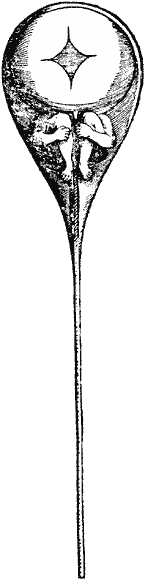
Both camps faced the question of where the preformed individuals came from. One answer was that they had all been created at once, at the beginning of the world, each nested inside the one before, rather like the nested dolls that fit inside each other and get forever smaller. In the version associated with Nicolas Malebranche, every future human being was already contained in the ovaries of the first woman; another group placed the series in the first man instead. The proposal seems outlandish now, but in the view of its supporters it also solved some vexing philosophical and theological problems.
Keep in mind that at the time these discussions were going on, people of course knew that sexual intercourse could lead to pregnancy, and recognized connections between pregnancy and the menstrual cycle. What was not understood was the biological process by which conception occurred.
In 1672 Regnier de Graaf described structures in the mammalian ovary that he and others took to be some kind of eggs. Of course, the eggs of birds and frogs were plain to see, which gave the ovists reason to think the organism began in the egg. But de Graaf’s structures turned out to be follicles, and the much smaller mammalian ovum inside them was not identified until Karl Ernst von Baer’s work in 1827 (Turriziani Colonna, 2017).
It was only in the 1870s that Oscar Hertwig, working with sea urchins, observed sperm entering the egg and the sperm and egg nuclei coming together (Garcia & Brind’Amour, 2007). In other words, preformationism took shape in the absence of almost everything that we would now consider basic to understanding reproduction.
The Epigenetic Answer
Epigenesis takes the second possibility. It is the idea that development involves the progressive formation and differentiation of new structures, rather than the growth of something already preformed. A fertilized frog egg, for example, becomes a tadpole and then an adult frog, but neither of those later forms is already there in the egg. The egg is an organized cell participating in a developmental process, and new structures arise as that process unfolds.
Epigenesis and epigenetics are related terms with different meanings. C. H. Waddington introduced the idea of epigenetics in the twentieth century to describe the developmental processes through which genotype becomes phenotype. Today, epigenetics often refers more narrowly to molecular processes that affect which genes are active without changing the DNA sequence itself, including chemical modifications to DNA and to histone proteins around which DNA is wrapped. These processes are important in development because cells with essentially the same DNA can become very different kinds of cells depending in part on which genes are active. It is epigenesis, not epigenetics, that concerns us here (Deans & Maggert, 2015).
Observations of development gave epigenesis more than a philosophical basis. In his 1759 dissertation Theoria generationis, the German anatomist Caspar Friedrich Wolff studied chick eggs at successive stages of incubation and described structures such as the blood vessels and heart taking shape over time (Ruffenach, 2009). What he observed did not look like a miniature organism simply becoming larger. Instead, parts appeared through changes in material that had not previously displayed the same organization, which led Wolff to argue that development involved the formation of new structure rather than the unfolding of structure already present.
Aristotle had reached a similar conclusion from his own observations of chick embryos, but Wolff brought the question into the microscopic study of development in the eighteenth century. Even so, observation did not settle the matter by itself. Preformationists could argue that the structures were present but too small, transparent, or otherwise inaccessible to be seen. Among the most influential defenders of this position was Albrecht von Haller, a Swiss anatomist and physiologist who was one of the leading scientific figures of the period. Haller had earlier been sympathetic to epigenesis, but by this point had become a committed preformationist and disputed Wolff’s interpretation.
Wolff also faced the harder question of what could produce organization if it was not already there. His answer was a vis essentialis, or essential force, which he associated with the processes of nutrition, growth, and formation. This was intended as a natural causal power rather than simply as an appeal to magic, but it remained unclear how the force generated the particular structures of a developing organism.
Epigenesis could therefore describe the gradual appearance of organization more convincingly than it could yet explain it. Preformationism avoided that problem by placing the organization at the beginning, although it did so largely by placing it beyond observation. Each position could expose the central weakness of the other, and neither yet provided a satisfactory explanation of development.
Why the Little Person Idea Lasted So Long
Given the force of Wolff’s case, why did preformationism keep its hold for as long as it did? Part of the answer is the explanatory difficulty we have just seen, because a theory that attributed organization to an essential force could be made to look less scientific than one that claimed the organization was already present. But there was more to it than that.
The apparent vagueness of epigenesis also sat badly with the science of the period. The scientific revolution of the 17th and 18th centuries emphasized mechanistic explanation and the reduction of complex processes to their component parts. Against that background, the little-person version of preformationism can be understood as an attempt to make the explanation of development more scientific, not less. There was no need for a mysterious process in which new features appeared out of nowhere. All the little person needed to do was grow bigger.
Cartesian mechanism made this position considerably easier to hold, even though Descartes himself had tried to explain the formation of the embryo mechanically. Aristotle had said that form and matter were bound together and could not be separated. Descartes instead proposed that body and soul were distinct and could be separated. On his view all bodies, human and animal alike, were matter that could be studied as machines, and only humans also had a rational, thinking soul.
For preformationists working within this framework, placing the organism’s initial organization in an act of creation allowed subsequent development to be treated as a mechanical process (Lawrence, 2008c). In a framework of this kind, the little person is a convenient proposal. You no longer need a pesky abstract “something else” to bring organization to unformed matter, because on this account nothing needs organizing in the first place.
Clearly this meant glossing over the new structures that embryos visibly develop. But never mind that: the soul could remain the domain of religion, and science could proceed. The gloss held for a surprisingly long time, in part simply because nobody had a better explanation to offer.
Driesch and the Sea Urchins
By the late nineteenth century, the miniature organism had long been abandoned, but a new version of the same logic had appeared. August Weismann proposed that the fertilized egg contains hereditary “determinants” that are divided among the cells as the embryo divides, so that each cell receives only what it needs to become one part of the body. In 1888, Wilhelm Roux seemed to confirm this. He killed one cell of a two-cell frog embryo with a hot needle, and the surviving cell developed into something like half an embryo (Fagan & Maienschein, 2026).
A turning point came in the spring of 1891, when Hans Driesch separated the cells of a developing sea urchin embryo at the two-cell stage, extending the work to later cleavage stages soon afterward. He found that separated early blastomeres could develop into complete larvae, smaller than usual but organized as wholes (Kearl, 2012).
This finding is difficult to reconcile with any account in which the parts of the future organism are fixed and shared out at the start. If each of the first two cells received the determinants for only half of the body, separating them should have produced half-larvae, as Roux’s result seemed to predict. Instead, each cell could still produce a whole. Something about the outcome of development was evidently not fixed in the starting material in the way that the picture required.
Although it was not part of the discussion at the time, human monozygotic twinning makes a related point using a case that we already know well. A single fertilized egg can, through more than one developmental route, give rise to two embryos. The developmental outcome is therefore not simply a matter of a fully formed individual already being present in the starting material.
You might think that Driesch’s findings would have put an end to the preformationist enterprise. They did not, partly because epigenesis had not meanwhile given up all of its secrets. Driesch himself eventually concluded that no machine could do what the separated cells had done, and turned to a vital force he called entelechy. The underlying problem remained unsolved.
In this sense preformationism was never really abandoned; it just took a different turn, and Weismann’s determinants already show which one. Instead of a little person that needed only to grow, the question became one of the information that is present at the beginning and that specifies the path of development. Once DNA came to be understood as carrying molecular sequences that are copied and passed on across generations, it became the natural candidate for where that information might be held. The structure of the explanation stayed exactly what it had been: something present at the start specifies the outcome, and development reads it out.
What Driesch Left Unexplained
It would be tempting to end here, with preformationism relocated and epigenesis vindicated, but that would be moving too quickly.
What Driesch showed was that the outcome of development is not fixed in the starting materials in the way that Weismann’s and Roux’s account required. What he did not show is where developmental organization actually comes from. The vitalist charge that preformationists leveled at epigenesis has not so much been answered as left behind. A position that is defined mainly by what it denies is not yet an explanation.
This is the debt that the rest of this section of About Development sets out to pay. If organization is not specified at the beginning, how does a recognizable life cycle recur so reliably across generations? What we need is an explanation of the organization itself.
The familiar language of genes and environment, or nature and nurture, gives us little help with that question. One way into the problem goes back to Aristotle, and to the question of what makes a living thing the kind of thing it is.
Sources
Deans, C., & Maggert, K. A. (2015). What do you mean, “epigenetic”? Genetics, 199(4), 887–896. https://doi.org/10.1534/genetics.114.173492
Fagan, M. B., & Maienschein, J. (2026). Theories of biological development. In E. N. Zalta & U. Nodelman (Eds.), The Stanford Encyclopedia of Philosophy. https://plato.stanford.edu/entries/theories-biological-development/
Garcia, B., & Brind’Amour, K. (2007). Wilhelm August Oscar Hertwig (1849–1922). Embryo Project Encyclopedia. https://embryo.asu.edu/pages/wilhelm-august-oscar-hertwig-1849-1922
Kearl, M. (2012). “The Potency of the First Two Cleavage Cells in Echinoderm Development. Experimental Production of Partial and Double Formations” (1891–1892), by Hans Driesch. Embryo Project Encyclopedia. https://embryo.asu.edu/pages/potency-first-two-cleavage-cells-echinoderm-development-experimental-production-partial-and
Lawrence, C. R. (2008a). Hartsoeker’s homunculus sketch from Essai de Dioptrique. Embryo Project Encyclopedia. https://embryo.asu.edu/pages/hartsoekers-homunculus-sketch-essai-de-dioptrique
Lawrence, C. R. (2008b). Ovism. Embryo Project Encyclopedia. https://embryo.asu.edu/pages/ovism
Lawrence, C. R. (2008c). Preformationism in the Enlightenment. Embryo Project Encyclopedia. https://hdl.handle.net/10776/1926
Ruffenach, S. (2009). Caspar Friedrich Wolff (1734–1794). Embryo Project Encyclopedia. https://embryo.asu.edu/pages/caspar-friedrich-wolff-1734-1794
Turriziani Colonna, F. (2017). De ovi mammalium et hominis genesi (1827), by Karl Ernst von Baer. Embryo Project Encyclopedia. https://embryo.asu.edu/pages/de-ovi-mammalium-et-hominis-genesi-1827-karl-ernst-von-baer
Explore Further
Dolnick, E. (2017). The seeds of life: From Aristotle to da Vinci, from sharks’ teeth to frogs’ pants, the long and strange quest to discover where babies come from. Basic Books.
An engaging popular history of the long and often strange effort to understand conception, including sperm, eggs, and preformationism.